Complete Dentures
A full set of removable replacement teeth on a gum-colored base for an upper or lower arch (or both) when all natural teeth in that arch are missing.
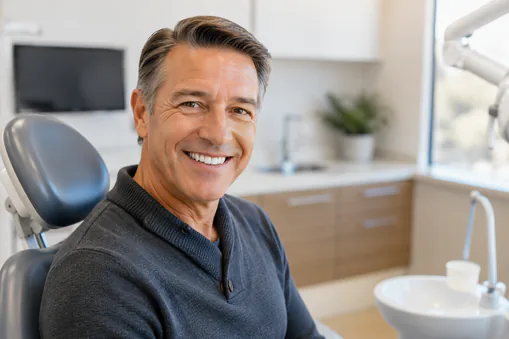
Complete, partial, and implant-retained dentures designed and fitted by a prosthodontist to restore chewing, speech, and a confident smile.
Clearbrook Advanced Dental Care in Cranbury, NJ designs and fits custom dentures — complete, partial, and implant-retained overdentures — to restore chewing function, speech, and facial support after tooth loss. As a prosthodontist, Dr. Adibe specializes in the design of replacement teeth, using precise impressions and custom shade matching so your dentures look natural and fit comfortably. Patients from Cranbury, Monroe, East Windsor, and Plainsboro trust Clearbrook for dentures that feel stable and look like their own teeth. Schedule a denture consultation or call (609) 395-9100.
Dentures are custom prostheses that replace missing teeth and the surrounding gum tissue. They restore the ability to eat, speak, and smile with confidence, and they support the lips and cheeks — preventing the collapsed look that follows tooth loss.
Depending on how many teeth are missing, dentures can be complete (replacing a full arch) or partial (replacing a few teeth while clasping to the remaining natural ones). Every denture is tailored to your mouth and color-matched to blend in. For patients who want maximum stability, an implant-retained option snaps onto implants and virtually eliminates slipping.
The best option depends on how many teeth are missing, the health of your gums and bone, and your goals for stability and budget. Dr. Adibe reviews each type with you.
A full set of removable replacement teeth on a gum-colored base for an upper or lower arch (or both) when all natural teeth in that arch are missing.
Replace one or several missing teeth while clasping securely to the remaining natural teeth with metal or precision attachments — preventing the others from shifting.
Placed the same day teeth are extracted so you are never without teeth during healing; later refined or relined as the gums settle.
Snap onto two or more dental implants for a dramatically more stable fit — far less movement when eating or speaking, and they slow jawbone loss.
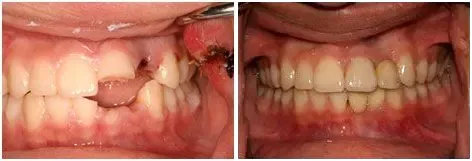
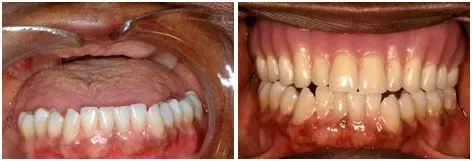
Real before-and-after results from Dr. Adibe's practice show how custom dentures restore a natural smile and a confident bite. More transformations are on our before & after gallery.
A patient with extensive tooth loss restored with a custom complete denture — natural shape, shade-matched teeth, and renewed facial support.
Several missing teeth replaced with a custom partial denture that clasps securely to the remaining natural teeth.
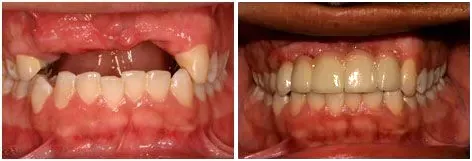
A loose, ill-fitting denture replaced with a well-fitted, custom prosthesis — comfortable for eating, speaking, and smiling.
Every denture case at Clearbrook Advanced Dental Care follows the same careful sequence — with a try-in stage so there are no surprises at delivery.
If any teeth need to be removed, that is planned first. Then Dr. Adibe takes precise impressions of your gums and records your bite:
A wax version of your dentures is tried in so you can see and approve the shape, shade, and smile line before the final is fabricated. Changes are made at this stage — you have a say in how your new smile looks.
The finished dentures are delivered and adjusted for comfort. You will practice eating and speaking, and Dr. Adibe makes fine tweaks. A few days later you return for sore-spot adjustments — most patients fully adapt within two to four weeks.
Adjusting to new dentures takes a little time and patience. Mild soreness or extra saliva is normal in the first days and settles quickly.
To help you adapt:
Most patients are comfortable and confident within a few weeks.
Dentures may be a good fit if you:
This may not be the ideal option if you:
Want a fixed, non-removable full arch instead? Consider All-on-4 dental implants.
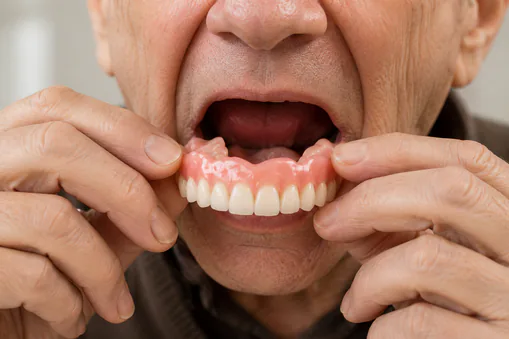
Here is how a traditional denture compares to an implant-retained option. Dr. Adibe reviews both with every patient so you can make the best-informed decision.
| Feature | Traditional Dentures | Implant-Retained |
|---|---|---|
| Stability while eating | Moderate (may use adhesive) | Very high (snaps onto implants) |
| Bone preservation | No — bone continues to resorb | Yes — implants stimulate bone |
| Chewing strength | 20–30% of natural teeth | Up to 70% of natural teeth |
| Speech changes | Common early on | Minimal |
| Removable at night | Yes | Yes (snaps off for cleaning) |
| Upfront cost | Lower | Higher |
These are the questions patients ask most often before committing to treatment. Dr. Adibe addresses each one honestly at your consultation.
Modern dentures use high-quality acrylic and custom shade matching. The shape and shade are refined at a wax try-in before finalizing, so the result looks natural — most people can't tell.
Slippage is the biggest complaint about traditional dentures. If it's a major concern, implant-retained dentures anchored to two or more implants eliminate the problem entirely and dramatically improve chewing strength.
Denture candidates span all ages — anyone with significant tooth loss from decay, gum disease, trauma, or a medical condition may benefit. Age has nothing to do with it.
Every treatment has tradeoffs, and a transparent conversation about them is part of informed care. Dr. Adibe reviews these at your consultation and answers every question before treatment begins.
The biggest complaint about traditional dentures is slippage. As a prosthodontist — a specialist in the design and fit of replacement teeth — Dr. Adibe focuses on getting the impression, bite, and try-in right so the finished denture is stable and comfortable from the start.
Every patient is walked through all available options, including implant-retained overdentures. Even two implants per arch can anchor a lower denture and eliminate the slipping concern completely — so the conversation is always about the best long-term fit for your mouth and budget, not a one-size-fits-all denture.
Reviewed by Dr. Adibe · Clearbrook Advanced Dental Care, Cranbury, NJ
Dentures are custom-made removable prostheses that replace missing teeth and the surrounding gum tissue. Complete dentures replace all the teeth in an arch; partial dentures replace a few teeth while clasping to the remaining ones. Immediate dentures are placed the same day teeth are removed, and implant-retained overdentures snap onto implants for far greater stability. Dr. Adibe helps you choose the right type at your consultation.
Brush your dentures daily with a soft-bristled brush and a mild cleanser, rinse them thoroughly, and store them in water or denture solution when they are out. Also brush your gums, tongue, and palate to keep tissue healthy. Bring your dentures to regular check-ups so the fit can be evaluated and adjusted.
It is generally recommended to remove dentures at night. This gives your gums and the underlying bone a chance to rest and recover, reduces the risk of irritation and fungal infection, and lets you clean the dentures thoroughly before the next day.
The lifespan of dentures varies with the type, material, and how they are cared for, but they typically last about five to ten years. Over time the jawbone changes shape, so dentures usually need a reline or replacement to keep fitting well.
It is common to notice small changes in speech while adjusting to new dentures, but with a little practice most people speak normally within a few weeks. Modern dentures use high-quality acrylic and custom shade matching, and the shape and shade are confirmed at a wax try-in before finalizing — so the result looks natural.
Loosening usually means the underlying bone has changed shape and the denture needs a reline or, eventually, a replacement. Do not use excessive over-the-counter adhesive to compensate — schedule an evaluation so the fit can be corrected. If looseness is a recurring problem, an implant-retained option may be worth discussing.
Yes. A cracked, chipped, or broken denture can often be repaired. Bring it in so it can be assessed and the appropriate repair recommended — avoid home repair kits, which can distort the fit and make a proper repair harder.
Yes. Clearbrook Advanced Dental Care in Cranbury, NJ designs and fits custom complete, partial, and implant-retained dentures for patients from Cranbury, Monroe, East Windsor, Plainsboro, and across Middlesex County. Schedule a consultation or call (609) 395-9100.
Medical Disclaimer
This content is for informational purposes only and does not constitute dental or medical advice, diagnosis, or treatment. Denture adjustment can take weeks, and sore spots, slippage, or changes in speech are common early on. Long-term, denture wearers experience accelerated jawbone resorption compared to implant-supported alternatives. Consult Dr. Adibe or a qualified dental professional regarding any questions about your oral health. Individual results may vary.
Schedule a consultation with Dr. Adibe to discuss which denture option fits your smile, comfort, and budget — and to get a personalized estimate.