Upper-Arch All-on-4
A full set of fixed upper teeth supported by four implants. The implants are positioned to take advantage of stronger bone in the upper jaw, often allowing treatment without a separate bone graft.
Replace a full arch of failing or missing teeth with a permanent, fixed bridge on four titanium implants — often with same-day teeth and no bone graft.
Clearbrook Advanced Dental Care in Cranbury, NJ offers All-on-4 dental implants — a full arch of permanent, fixed teeth supported by just four titanium implants, often loaded with a provisional bridge the same day. Dr. Adibe uses CBCT 3D imaging to map bone volume and nerve position before surgery, so patients can avoid bone grafting in most cases. Whether you have failing teeth, an ill-fitting denture, or advanced bone loss, All-on-4 restores chewing strength, facial support, and confidence. Schedule your consultation or call (609) 395-9100 to see if you are a candidate.
The All-on-4 technique uses four titanium posts strategically placed along the jaw to support a complete fixed bridge. By angling the two rear implants forward, they anchor in the denser bone at the front of the jaw and avoid the sinuses — which is why most patients can be treated without a separate bone graft.
Unlike a removable denture that rests on the gums and relies on suction or adhesive, an All-on-4 bridge is fixed in place. It does not slip when you eat or speak, and because the implants stimulate the jawbone, they help slow the bone loss that causes the "sunken" facial look of long-term denture wear.

All-on-4 is adapted to the upper or lower arch, your bone condition, and your goals for stability, function, and budget. Dr. Adibe reviews each option with every candidate.
A full set of fixed upper teeth supported by four implants. The implants are positioned to take advantage of stronger bone in the upper jaw, often allowing treatment without a separate bone graft.
Four implants restore an entire lower arch. The dense lower jawbone often provides excellent primary stability — ideal for patients tired of a loose lower denture.
In most cases a provisional fixed bridge is attached the same day the implants are placed, so you leave with teeth — no gap and no removable denture during healing.
When budget or anatomy is a factor, an implant-retained overdenture (which snaps in and out) can be an alternative to a fully fixed All-on-4 bridge. Both are reviewed at your consult.
Real before-and-after results from Dr. Adibe's practice show what All-on-4 can do for a failing or missing arch of teeth. More transformations are on our before & after gallery.
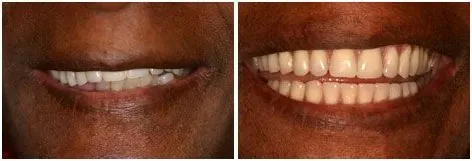
A failing upper arch replaced with a fixed, implant-supported bridge on four implants — a complete, stable set of teeth in place of loose, painful teeth.
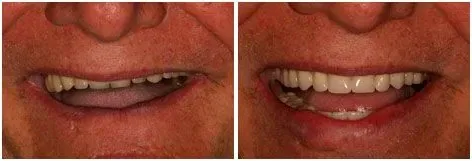
An ill-fitting removable denture replaced with a full-arch All-on-4 prosthesis — no more adhesive, slipping, or removing teeth at night.
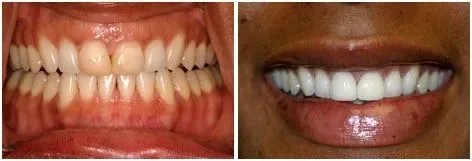
A full arch of missing and broken-down teeth rebuilt with a permanent, lifelike zirconia bridge anchored to titanium implants.
Every All-on-4 case at Clearbrook Advanced Dental Care follows the same disciplined sequence, planned digitally before surgery.
Dr. Adibe takes a 3D scan of your jaw and digitally plans the exact position, angle, and depth of each of the four implants:
Under local anesthesia (with nitrous oxide available for relaxation), Dr. Adibe places the four implants — two straight, two angled — in about two hours per arch. Most of the procedure is felt as pressure and vibration, not pain. Before you leave, a provisional fixed bridge is attached, so you walk out with a full set of teeth that day.
Over three to four months the implants fuse with the bone (osseointegration) while you follow a soft-food diet and return for check-ups. Once healing is complete, the provisional is replaced with a final zirconia or acrylic bridge — durable, lifelike, and matched to your smile.
Your first appointment is a comprehensive consultation: medical and dental history, CBCT imaging, an examination of your remaining teeth and gums, and a conversation about your goals.
For surgery, comfort options include:
For patients with dental anxiety, we walk through the visit step-by-step beforehand so it feels predictable.
All-on-4 may be a good fit if you are:
This may not be the right option if you have:
Prefer to replace teeth one at a time? Explore single and multiple dental implants or implant-supported dentures.

Here is how All-on-4 compares to the two most common alternatives for replacing a full arch of teeth. Dr. Adibe reviews all three options with every candidate during consultation.
| Feature | All-on-4 | Traditional Dentures | Individual Implants |
|---|---|---|---|
| Number of implants | 4 per arch | 0 | 8–12 per arch |
| Removable | No — fixed | Yes — daily | No — fixed |
| Bone graft needed | Rarely | No | Often yes |
| Bite strength restored | Up to 90% | 20–30% | Up to 95% |
| Prevents bone loss | Yes | No — accelerates it | Yes |
| Same-day teeth | Usually yes | Yes | No — months of healing |
These are the questions patients ask most often before committing to treatment. Dr. Adibe addresses each one honestly at your consultation.
All-on-4 is a long-term investment that typically costs less than replacing multiple failing teeth one implant at a time. We provide a personalized quote after CBCT planning and offer payment options so you can spread the investment over time.
All-on-4 is performed under local anesthesia with nitrous oxide available for relaxation — most patients describe it as far less intense than they expected. Recovery is typically a few days, and you leave the same day with teeth.
Traditional dentures rest on the gums and slip. All-on-4 is anchored to four titanium implants fused to the jawbone — the bite force is dramatically stronger, bone loss is slowed, and there is no adhesive or slipping.
Every procedure has tradeoffs, and a transparent conversation about them is part of informed consent. Dr. Adibe reviews these at your consultation and answers every question before treatment begins.
The All-on-4 protocol is used to bypass complex bone grafting in the vast majority of cases. By angling the two posterior implants forward, they anchor in the denser anterior jawbone — where the bone holds up best over time — and the sinuses and nerves are avoided without additional surgery.
Long-term success depends on planning and maintenance. CBCT 3D imaging is used for every case to map bone and nerves before the first incision, and as a prosthodontist, Dr. Adibe designs the surgical placement and the final bridge together so the finished arch fits the bite and looks natural. A maintenance schedule is built with every patient to protect the investment.
Reviewed by Dr. Adibe · Clearbrook Advanced Dental Care, Cranbury, NJ
All-on-4 is a technique that replaces a full arch of teeth with a fixed bridge supported by just four titanium implants. Two implants are placed straight in the front of the jaw and two are angled in the back, anchoring in the densest available bone. Because the angled implants avoid the sinuses and nerves, most patients can be treated without a separate bone graft.
In most cases, yes. After the four implants are placed, a provisional (temporary) fixed bridge is attached the same day — so you walk out with a full set of teeth and never go without a smile. The final zirconia or acrylic bridge is fitted after the implants integrate with the bone, usually three to four months later.
The titanium implants are designed to last decades and often a lifetime with proper care. The bridge attached to them may eventually need maintenance or replacement after many years of use, depending on the material and wear. Daily cleaning under the bridge and regular maintenance visits are essential to long-term success.
An All-on-4 bridge is designed to sit close to the gum so food does not collect underneath the way it can with a poorly fitting denture. You will clean beneath the bridge daily with a water flosser or special floss threader — Dr. Adibe shows you the technique at the delivery appointment.
Brush the bridge like natural teeth and clean underneath it daily with a water flosser or floss threader, plus a non-alcoholic antibacterial rinse. An electric toothbrush helps. Brushing your tongue and the inside of your cheeks keeps bacteria and odor down. Professional maintenance visits keep the implants and gums healthy.
It is not required. Many patients are comfortable with local anesthesia alone, and nitrous oxide is available for relaxation. The procedure is done at our Cranbury office without hospitalization. Dr. Adibe reviews comfort options with you before surgery.
Most patients return to normal activity within a few days. A soft-food diet is recommended for several weeks while the implants integrate with the jawbone (osseointegration). The final bridge is typically placed three to four months after surgery, once healing is complete.
As with any surgical procedure, All-on-4 carries some risk — including post-surgical infection, implant failure (rare, usually from bone not fully integrating), nerve irritation, sinus involvement on the upper arch, and peri-implantitis (bone loss around an implant) if hygiene is neglected. Dr. Adibe reviews your full medical history and CBCT imaging before surgery to minimize these risks.
Yes. Clearbrook Advanced Dental Care in Cranbury, NJ offers All-on-4 dental implants to patients from Cranbury, Monroe, East Windsor, Plainsboro, and across Middlesex County. Schedule a consultation or call (609) 395-9100.
Medical Disclaimer
This content is for informational purposes only and does not constitute dental or medical advice, diagnosis, or treatment. All-on-4 is a surgical procedure and carries risks including infection, implant failure, nerve irritation, and bone loss. Candidacy depends on overall health, bone volume, and oral condition as evaluated by a dentist. Consult Dr. Adibe or a qualified dental professional regarding any questions about your oral health. Individual results may vary.
Schedule a consultation with Dr. Adibe to find out whether All-on-4 is right for you and to get a personalized treatment plan and estimate.